

Creating a Lindy Smartphone
This Week in SLEKE: Issue #9

We’re glad you’re here! If you believe smartphones should assist us in daily life rather than distract us from it, please consider subscribing and sharing our work. Building awareness and momentum is how we create change and a better path forward.
If you’ve never heard of the Lindy concept, it basically is used to describe something that is time tested, durable, and anti-fragile. It originated in the 1950’s in New York. Lindy’s was a place where comedians and Broadway performers hung out. It was observed by the performers that the longer a show had been running, the more likely it was to keep running. Thus the “Lindy Effect” was born, and the idea that things that endure tend to keep on enduring.1

Part of the joy and the challenge behind developing the SLEKE phone is in trying to create a product that will endure and last. A product that is Lindy. And one aspect of our phone that other “dumbphone” proponents might find peculiar is that email is allowed on our phone. For some, that might seem to go against the dumbphone philosophy. Which, yeah, maybe it does. But that’s why the SLEKE phone is different. It’s not a dumbphone. Our subreddit is cheekily called r/TheSmartDumbphone. But demand for something akin to a dumbphone tells us something important. The subreddit r/dumbphones has about 169,000 followers as of today and is in the top 1% to 2% of all active subreddits based on size. There is a demand for an alternative to mainstream smartphones. People are waking up to the fact that a smartphone without boundaries is simply a vehicle for fracking your attention. Yet we are handcuffed to them because so many genuinely need them for day-to-day life. Insert SLEKE phone, with its values-based OS and design ethos. No attention fracking allowed.
So, back to email. The reason email is on the SLEKE phone is because email is Lindy.
wrote a great piece earlier this year called, “In praise of email.” In it, he also makes the claim that email is lindy. He writes about how the modern internet is dominated by platforms and that what we see on these platforms is driven by their algorithms. Algorithms that “determine which voices rise and which are buried.” Clickbait, in this sense, is perversely incentivized. Next time you find yourself outraged on X/Twitter, remember that your outrage and attention is basically being monetized.Email, on the other hand, from Singer:
Email by contrast is profoundly democratic. It’s chronological. Egalitarian. Everything you’ve subscribed to arrives in your inbox, not filtered through opaque mechanisms that decide what’s worthy of your attention. Contrasted with social’s algorithmic opacity, your inbox is a rare place of clarity. There’s no AI gatekeeper deciding whether the blog you signed up for two months ago aligns with your current ‘interests’ as interpreted by recent scrolling habits. It’s just there in its unmediated, raw state.
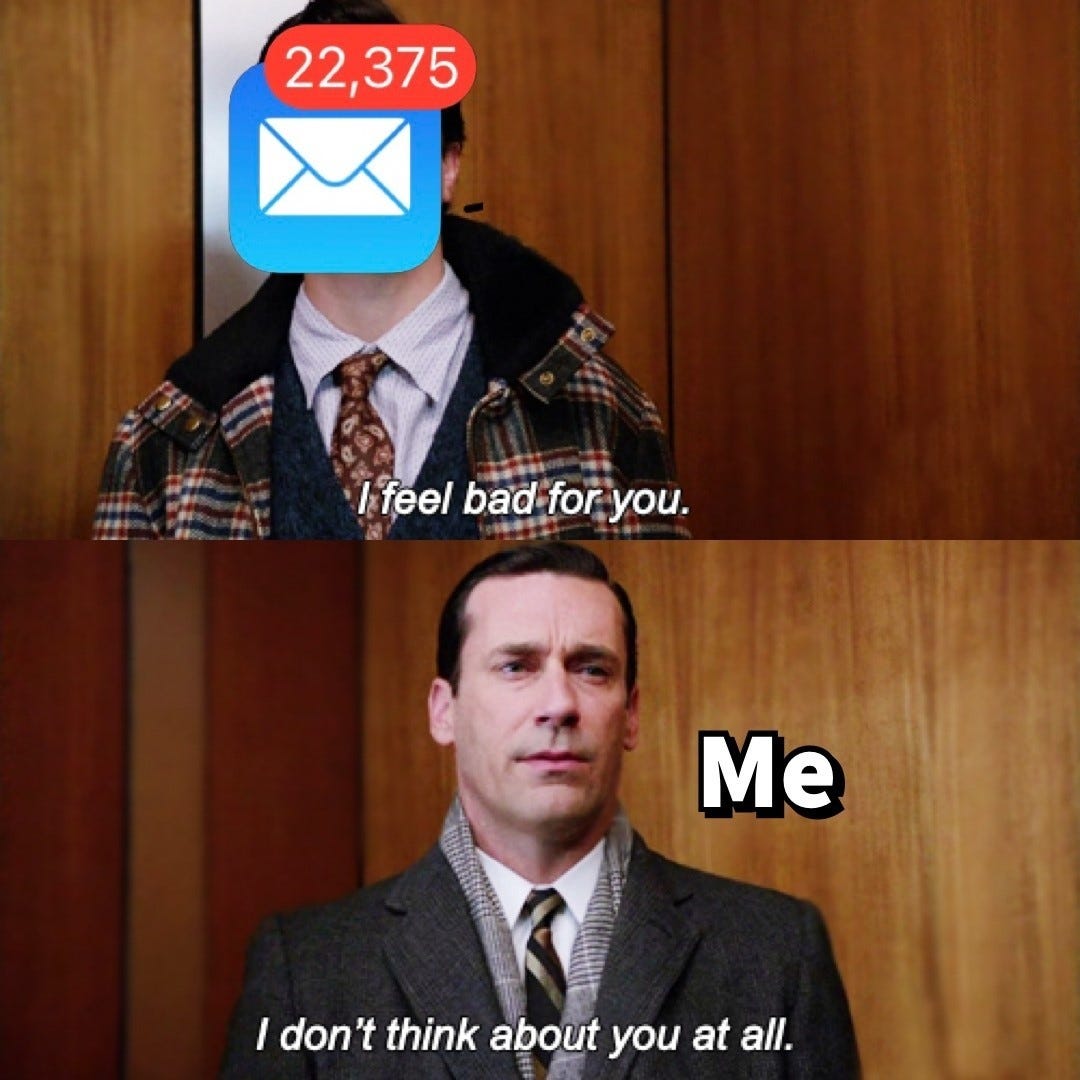
Email is one of the last bastions of algorithm free internet content. It’s a place where the User has complete control of what is allowed inside the walls. Singer mentions that he keeps a diligently clean inbox, and that it is an important piece of housekeeping as it pertains to email. To each their own here (I’ve seen many an inbox with 10,000+ unread emails), but if you don’t prune your email inbox, it will turn into a spam fest. But most modern email providers have robust unsubscribe and spam filter services so that your email inbox can remain chronological, algorithm-free, ad-free, and high signal.
What makes email different is that it’s private. As Singer puts it:
This directness also makes email intimate in a way that platforms can never replicate. An email arrives addressed to you. It enters a digital space that feels and is private. It’s not performing for an audience of thousands or millions, it’s speaking to you alone. And in an age where so much online communication is performance, this intimacy is something different, something more important.
We hope that what will make the SLEKE phone Lindy is that it is a device that is intimate and personal. That may sound like an odd way to describe a smartphone, but these devices are virtual appendages for human beings. And they are devices that unconsciously beckon users to perform throughout their life. Each and every iPhone user with a social media app downloaded has the eyeballs of the internet just waiting for them to perform in some way. In that sense, it’s not too much to ask that these companion devices be intentionally designed with the aim that they embody a level of care and respect for the User. The antidote to attention fracking devices is pretty simple, actually. It’s devices that don’t frack your attention. The strategy of getting there can be a bit complex, but the antidote is devices that have boundaries and take on the idea that what is omitted from the device is just as important as what is included.
If anyone reading has any ideas around what would make a phone Lindy, we’d love to hear your thoughts. While we have an overarching philosophy that has a firm set of boundaries, the phone continues to be formed by our early community of Users who interact with the phone every day. We want to continue iterating on the idea of how to create a Lindy device. In that light, we’d love to hear from Users about what essential, non-attention-fracking components would make a phone genuinely additive to life.
We hope everyone has a great weekend.
As always,
Do Cool Stuff.
What We’re Reading, Watching and Listening to:
This is Your Brain on Phones: Deep Questions with Cal Newport
Here’s a quote from Cal Newport in his intro for this podcast episode:
For some people, the constant allure of their phone is so strong, it’s so inescapable that it can seem impossible to find any sort of freedom. This is what I want to talk about today. How to create relief from your phone overuse to gain enough breathing room that you can actually pay attention to making the other parts of your life more meaningful.
What we’re doing at SLEKE is creating a smartphone that in and of itself is a remedy to the problem that Newport lays out. You should have a device that you don’t feel the need to go to war with every day. We shouldn’t have to listen to a 90 minute podcast episode to develop a strategy to find relief from phone overuse. The remedy is intentional design! Getting to the root problem is creating a phone that doesn’t cause the problem in the first place. So much of the modern mitigation attempts to curb screentime address the symptom, but not the cause. The device design itself is the root cause. What makes us different is that SLEKE is not a band-aid.
Lesser Apes by
This post is a thoughtful look at how offloading our thinking to AI might be making us less capable, and why we should deliberately choose harder mental work over convenient automation. Recent stats are worrying about the effects of AI and modern tech on the intellects and literacy of both young people and adults. Awareness is the first step, but we need to turn that awareness into willful action. Getting a SLEKE phone is an action one can take. Reducing your screen time by a few hours a day is a step in the right direction.
Get a free humanities education on YouTube by
The internet is an intricate labyrinth with endless information and rabbit holes. As Adam Singer noted in his piece, ~720,000 hours of video are uploaded to YouTube per day. But, while we are saturated with content, if you can wade through the mud, there is a treasure trove of valuable information. This piece by Jo Shaw is a great treasure map for those who might not be as adept at navigating the labyrinth as others. For the self-motivated, there are enough links in this piece to get, as the title claims, a virtually free humanities education on YouTube. Whether or not someone has the willpower to fight off the distracting elements of the internet while pursuing this is another problem entirely. But it’s pretty cool that we do have this type of information at our fingertips if we choose to grab it.